Sports Physics Simulator
Equipment Parameters
Physics Analysis
Real-timeHave you ever wondered why a tennis ball bounces higher on hard courts than on clay? Or why a golf club feels different when it’s made of titanium versus steel? It’s not magic. It’s physics. When we talk about sports equipment through the lens of physical science, we aren’t just looking at plastic, metal, or fabric. We are looking at tools designed to manipulate forces, transfer energy, and optimize human movement.
In physical science, sports equipment serves as an interface between the athlete’s body and the laws of nature. Every swing, throw, jump, or kick involves complex interactions governed by mechanics, thermodynamics, and material science. Understanding these principles helps athletes improve performance, engineers design better gear, and fans appreciate the hidden complexity behind every game-winning play.
The Mechanics of Motion: Newton’s Laws in Action
At its core, physical science relies heavily on classical mechanics. Sir Isaac Newton’s three laws of motion explain almost everything that happens with sports equipment. Let’s break down how these laws apply directly to what you see on the field or court.
Newton’s First Law (Inertia) states that an object at rest stays at rest unless acted upon by an external force. Think about a soccer ball sitting on the penalty spot. It won’t move until a player kicks it. The mass of the ball determines how much force is needed to change its state. Heavier balls require more force to accelerate. This is why youth leagues use smaller, lighter balls-they reduce the inertia, making it easier for developing muscles to generate speed.
Newton’s Second Law (F=ma) connects force, mass, and acceleration. In baseball, this law dictates bat speed. A batter wants to maximize the acceleration of the bat head. By using a lighter bat (reducing mass), they can swing faster (increasing acceleration) while applying the same muscular force. The result? More power transferred to the ball upon impact. However, there’s a trade-off: too light, and the bat lacks momentum; too heavy, and swing speed drops. Finding the sweet spot is pure applied physics.
Newton’s Third Law (Action-Reaction) explains recoil and propulsion. When a sprinter pushes off the starting blocks, the blocks push back with equal force. Similarly, when a basketball hits the rim, the rim exerts an equal and opposite force, causing the ball to bounce away. Equipment designers use this principle to create surfaces that return energy efficiently-like the responsive soles of running shoes or the stiff strings of a racquet.
Energy Transfer and Elasticity
One of the most critical concepts in sports equipment physics is energy transfer. Specifically, we look at Kinetic Energy, which is the energy of motion. The formula for kinetic energy is $KE = \frac{1}{2}mv^2$. Notice that velocity is squared. This means doubling your speed quadruples the energy. That’s why fast pitchers hurt more than slow ones, even if the ball weighs the same.
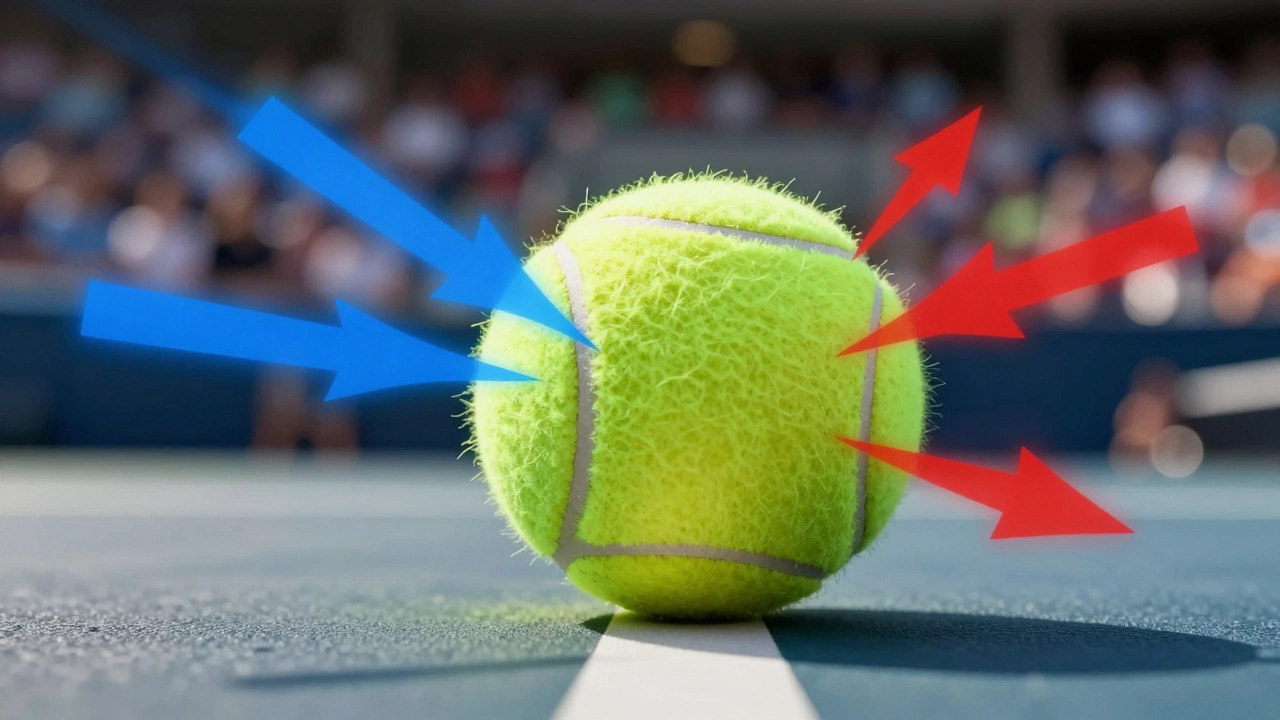
When equipment strikes an object, energy isn’t always perfectly transferred. Some energy is lost as heat, sound, or deformation. This brings us to Elasticity. Elastic materials deform under pressure but return to their original shape, storing and releasing energy like a spring. Rubber balls, trampoline mats, and bow limbs all rely on high elasticity.
- High Elasticity: Tennis balls and golf clubs. They store energy during compression and release it rapidly, propelling the ball forward.
- Low Elasticity (Plastic Deformation): Clay targets in shooting or crumple zones in protective gear. These absorb energy permanently to protect the user.
The coefficient of restitution (COR) measures how bouncy an object is. A COR of 1.0 means perfect elastic collision (no energy loss). Real-world sports equipment rarely exceeds 0.85 due to air resistance and internal friction. Engineers tweak materials to get as close to ideal efficiency as regulations allow.
Aerodynamics and Fluid Dynamics
If the sport involves moving through air or water, fluid dynamics becomes king. Air resistance, or drag, slows objects down. Drag depends on surface area, shape, and speed. Cyclists crouch low to minimize frontal area. Swimmers wear tight suits to reduce skin friction.
Sports equipment often uses aerodynamic shaping to cut through air. Golf balls have dimples-not for style, but to create a turbulent boundary layer that reduces drag and increases lift. Without dimples, a golf ball would fly half the distance. Similarly, footballs (American) are spiraled to stabilize flight via gyroscopic effect, reducing wobble and maintaining a streamlined path.
In swimming, Hydrodynamics plays a similar role. Flippers increase surface area to push more water backward, generating greater forward thrust according to Newton’s Third Law. But larger flippers also increase drag when kicking up. Designers balance blade size, stiffness, and flexibility to match the swimmer’s strength and stroke type.

Material Science: Strength vs. Weight
Modern sports equipment owes much to advances in material science. Early bats were wood. Today, composite materials like carbon fiber and graphite dominate. Why? Because they offer superior strength-to-weight ratios.
| Material | Density (g/cm³) | Tensile Strength (MPa) | Common Use |
|---|---|---|---|
| Aluminum Alloy | 2.7 | 300-600 | Baseball bats, bike frames |
| Carbon Fiber Composite | 1.5-1.6 | 3,500-7,000 | Tennis rackets, ski poles |
| Titanium | 4.5 | 900-1,200 | Golf club heads, prosthetics |
| Steel | 7.8 | 400-2,000 | Weightlifting bars, fencing foils |
Carbon fiber is lightweight yet incredibly strong. It allows tennis players to swing faster without sacrificing durability. Titanium resists corrosion and absorbs vibration, making it ideal for golf clubs where feel matters. Steel remains popular for weightlifting because its density provides consistent heft, crucial for building muscle memory.
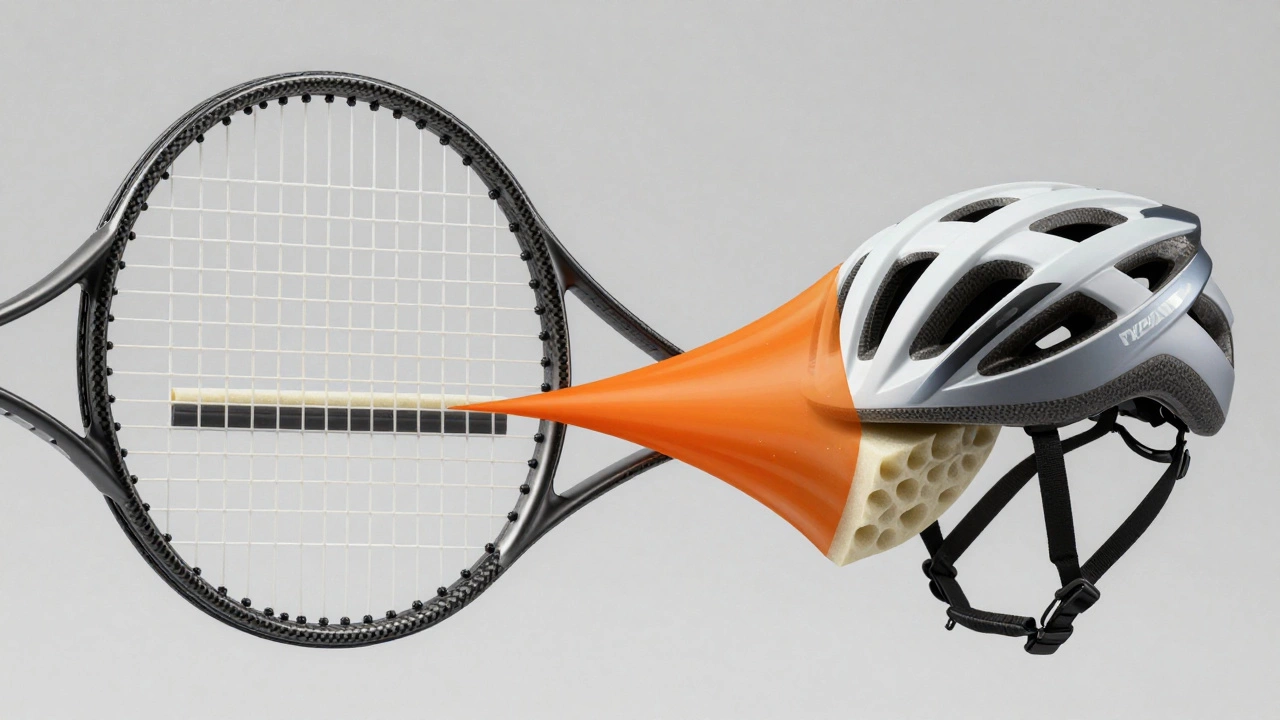
Material choice also affects safety. Helmets use expanded polystyrene (EPS) foam to crush upon impact, absorbing kinetic energy that would otherwise reach the skull. This controlled deformation saves lives by extending the time over which deceleration occurs, reducing peak force on the brain.
Biomechanics: The Human-Equipment Interface
Sports equipment doesn’t exist in isolation-it interacts with the human body. Biomechanics studies how muscles, bones, and joints work together with gear to produce movement. Poorly fitted equipment can lead to injury or inefficiency.
Consider running shoes. They’re not just footwear; they’re shock absorbers and levers. The midsole cushioning reduces impact forces on knees and hips. The heel-to-toe drop influences ankle angle and calf strain. Runners who switch from high-drop to zero-drop shoes must adapt their gait, changing how force travels through their legs.
Cycling pedals illustrate another key point: leverage. Clipless pedals lock your foot to the bike, allowing you to pull up as well as push down. This doubles the points of force application per pedal stroke, increasing efficiency. But improper cleat placement can cause knee pain by misaligning joint angles. Here, physics meets physiology.
Friction and Traction
Without friction, sports wouldn’t exist. You couldn’t run, grip a bat, or stop a car. Friction arises from microscopic irregularities between surfaces. Coefficient of friction ($\mu$) quantifies this relationship.
Cleats on soccer boots dig into grass, increasing traction by interlocking with soil particles. Ice skates melt a thin layer of ice beneath the blade, creating a lubricating film that reduces friction dramatically. Climbing chalk dries sweat, restoring friction between hands and rock holds. Each solution addresses specific environmental challenges using fundamental physical principles.
Racquet string tension also affects friction. Tighter strings provide less dwell time (contact duration) but more control. Looser strings increase dwell time, trapping the ball longer and adding spin. Spin itself relies on friction between string and ball surface, altering trajectory via the Magnus Effect-a phenomenon where spinning objects curve in flight due to pressure differences in surrounding air.
Thermodynamics in Extreme Conditions
While less obvious, thermodynamics impacts sports equipment too. Heat generation occurs during rapid deformation or friction. Skis warm up after repeated runs, affecting wax performance. Bicycles brake pads overheat during long descents, reducing stopping power. Athletes’ bodies generate heat, requiring clothing that manages moisture and insulation.
Winter sports gear must handle cold-induced brittleness. Plastic components become fragile below freezing. Manufacturers add plasticizers to maintain flexibility. Conversely, summer gear focuses on ventilation and UV resistance. Fabrics with phase-change materials absorb excess body heat, keeping athletes cool during intense exertion.
How does physics affect ball bounce?
Ball bounce depends on elasticity and surface hardness. Harder surfaces like concrete return more energy, resulting in higher bounces. Softer surfaces like grass absorb energy, lowering bounce height. Internal air pressure also matters-higher pressure creates stiffer walls, enhancing rebound.
Why do some sports balls have seams or panels?
Seams disrupt airflow around the ball, influencing drag and stability. Soccer balls with fewer panels roll smoother and fly straighter. Cricket ball seams enable bowlers to induce swing by manipulating air turbulence on one side.
Does heavier equipment mean better performance?
Not necessarily. Heavier equipment carries more momentum but requires more force to accelerate. Lighter gear enables faster movements. Optimal weight balances speed and power based on individual athlete strength and sport demands.
How do helmets protect the brain?
Helmets use crushable foam layers to extend impact duration. By slowing deceleration gradually, they reduce peak force transmitted to the skull and brain. Proper fit ensures even distribution of force across the head.
Can weather conditions change how equipment performs?
Yes. Temperature affects material stiffness and air density. Cold makes plastics brittle and thickens oils in bearings. High humidity alters friction coefficients. Altitude changes air pressure, impacting ball flight and oxygen availability for athletes.