Strength Progression & Volume Calculator
Plan Your Lift
Analysis & Recommendations
Enter your current stats and click calculate to see your total volume and progression targets.
Stop wasting your time on machines
You've probably seen it in every gym: people spending an hour on a leg extension machine or doing endless sets of bicep curls while their posture slowly collapses. If you want the most bang for your buck, you have to stop thinking about muscles in isolation and start thinking about movement patterns. The secret to a body that actually performs in the real world isn't found in a dozen different machines; it's found in a few heavy, demanding movements that force your entire system to work together.
If you only have three days a week to train, or if you're just tired of feeling like you're spinning your wheels, you need a foundation based on compound exercises. These are movements that hit multiple joints and muscle groups at once. Why? Because that's how your body actually works. You don't just "quad" a box off the ground; you squat, hinge, and push. By focusing on the four primary movement patterns-the squat, the hinge, the push, and the pull-you build a level of strength that carries over into everything from carrying groceries to hiking a trail.
Key Takeaways
- Focus on compound movements over isolation exercises to maximize efficiency.
- Prioritize the Squat, Deadlift, Bench Press, and Row/Pull-up.
- Progressive overload is the only way to keep seeing results.
- Form always beats weight; a bad rep is a wasted rep.
The King of Lower Body: The Squat
If you could only do one exercise for the rest of your life, it should probably be some variation of the squat. Squatting is a fundamental movement pattern where you lower your hips from a standing position and then stand back up. It isn't just about your legs; it's a full-body effort that demands core stability and balance.
When you perform a barbell back squat, you're engaging your quadriceps, glutes, hamstrings, and your entire spinal erector group. For someone who spends eight hours a day sitting in an office chair, the squat is a literal lifesaver. It fights muscle atrophy in the posterior chain and improves hip mobility. If you can't handle a barbell yet, start with goblet squats-holding a dumbbell at your chest-to learn how to keep your torso upright without tipping over.
The real magic happens when you hit a depth where your hip crease is below the top of your knee. This is where you get the maximum stretch and growth. If you find your heels lifting off the floor, you might have tight ankles, which is common. Try placing small plates under your heels or focusing on ankle mobility drills before your first set.
The Powerhouse: The Deadlift
While the squat is about pushing, the Deadlift is the ultimate test of raw strength. It is a hinge movement that involves lifting a weighted barbell from the floor to the hips. If the squat is the king, the deadlift is the emperor. It targets the "posterior chain"-the muscles on the back of your body that you can't see in the mirror but that do all the heavy lifting in life.
Many people are terrified of deadlifting because they've heard horror stories about back injuries. But here's the truth: you're more likely to hurt your back picking up a heavy couch with bad form than you are doing a controlled deadlift. The key is the "hinge." You aren't squatting the weight up; you are pushing your hips back as if you're trying to close a car door with your butt.
Whether you prefer the conventional style (feet narrow) or the sumo style (feet wide), the goal is the same: maintain a neutral spine. If your back rounds like a cat, the weight is too heavy. Lower the load, engage your lats-imagine you're trying to squeeze an orange in your armpits-and pull the slack out of the bar before you drive through the floor.

The Upper Body Anchor: The Push
To balance out the pulling and lower-body work, you need a dedicated pushing movement. While there are many options, the Bench Press remains the gold standard for upper-body power. This is a compound exercise where you lie on a bench and press a weight away from your chest, primarily targeting the pectorals, anterior deltoids, and triceps.
However, the bench press isn't the only way to "push." If you want more shoulder health and functional stability, you should incorporate the overhead press. Pushing weight vertically over your head forces your core to lock tight and your shoulders to stabilize. In a perfect world, you'd alternate between these two: one day focusing on the horizontal push (chest) and the next on the vertical push (shoulders).
A common mistake is bouncing the bar off the chest. That doesn't build muscle; it just risks a bruised ribcage. Control the descent, touch your chest lightly, and explode upward. If you find your shoulders clicking, try using dumbbells. They allow for a more natural range of motion and prevent your dominant side from doing all the work.
The Essential Balance: The Pull
If you only push and never pull, you'll eventually end up with "caveman posture"-shoulders rolled forward and a rounded upper back. To fix this, you need the Row or the pull-up. Pulling exercises involve bringing a weight toward your body or pulling your body toward a bar, targeting the latissimus dorsi, rhomboids, and biceps.
The barbell row is fantastic for building a thick back, but the pull-up is the ultimate measure of relative strength. Being able to move your own body weight is a non-negotiable skill. If you can't do a single pull-up yet, don't sweat it. Use a resistance band for assistance or start with "negatives"-jump to the top of the bar and lower yourself as slowly as possible.
The goal here is scapular retraction. Don't just pull with your arms; imagine you're trying to pinch a pencil between your shoulder blades. This ensures the big muscles of the back are doing the work, rather than just your biceps. When you combine a strong pull with a strong push, you create a stable, balanced shoulder girdle that can handle almost any physical challenge.
| Exercise | Primary Pattern | Key Muscles Target | Real-World Use |
|---|---|---|---|
| Squat | Knee Dominant | Quads, Glutes, Core | Sitting/Standing, Lifting |
| Deadlift | Hip Hinge | Hamstrings, Lower Back, Glutes | Picking up heavy objects |
| Bench Press | Horizontal Push | Chest, Triceps, Shoulders | Pushing a door or object |
| Row / Pull-up | Horizontal/Vertical Pull | Lats, Rhomboids, Biceps | Climbing, Pulling open a door |
How to Actually Get Stronger
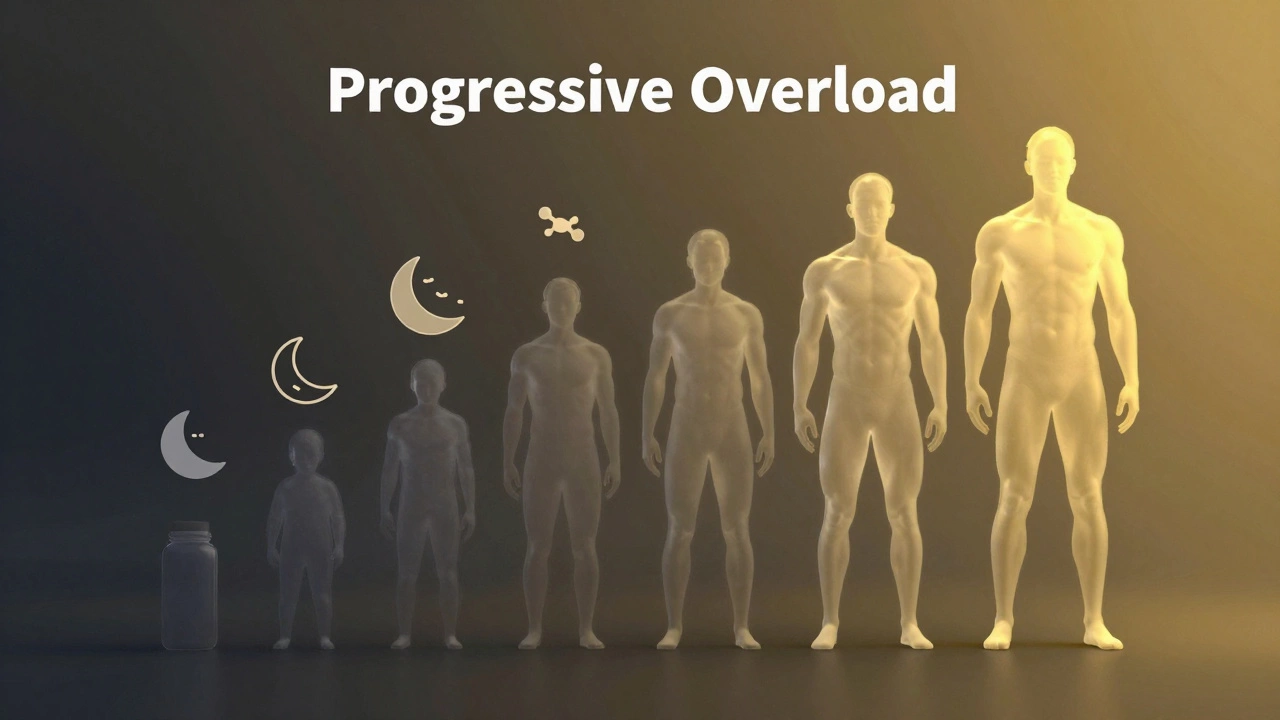
Knowing what to do is only half the battle; the other half is how you do it. You cannot do the same weight for the same reps every week and expect your body to change. Your body is an adaptation machine. If the challenge doesn't increase, the adaptation stops. This is called Progressive Overload, and it's the only way to grow.
Progressive overload doesn't always mean adding more plates to the bar. While that's the most obvious method, there are other ways to make a workout harder:
- Increase Volume: Instead of 3 sets of 8, try 4 sets of 8.
- Slow Down: Increase the "time under tension" by taking 3 seconds to lower the weight.
- Reduce Rest: Instead of resting 3 minutes, try 90 seconds.
- Improve Form: Doing a weight with perfect control is harder than swinging it with momentum.
A simple rule of thumb is the "Double Progression" method. Pick a rep range, say 8 to 12. Once you can perform all sets with 12 clean reps, increase the weight slightly. You'll likely drop back down to 8 reps with the new weight. Work your way back up to 12, and repeat the process. This keeps you moving forward without hitting a wall or risking injury by jumping weights too quickly.
Common Pitfalls and How to Avoid Them
One of the biggest mistakes beginners make is chasing a number on the bar at the expense of their joints. I've seen people deadlift 200kg with a spine that looks like a question mark. That's not strength; that's a countdown to a disc herniation. If you can't maintain a flat back, the rep didn't happen. Be honest with yourself.
Another issue is the "ego trap." You might feel pressured to keep up with the person next to you, but your only competition is the version of you from last week. If you're shaking uncontrollably or holding your breath until your face turns purple (which, while common in powerlifting, isn't great for casual fitness), you're likely overreaching. Focus on the mind-muscle connection. Feel the glutes drive the weight up in a squat; feel the lats engage in a row.
Finally, don't ignore recovery. These four workouts are incredibly taxing on the Central Nervous System. You don't grow in the gym; you grow while you sleep. If you're training these heavy compounds every single day, you'll burn out or get injured within a month. Give yourself at least 48 hours between hitting the same muscle group. Eat enough protein-roughly 1.6g to 2.2g per kilogram of body weight-and get your eight hours of shut-eye.
Can I do these workouts at home without a gym?
Yes. You can substitute a barbell squat with air squats or Bulgarian split squats using a chair. A deadlift can be mimicked with a weighted bag or by doing "good mornings." For pushing, push-ups are a perfect substitute for the bench press. For pulling, you can do inverted rows using a sturdy table or find a local park with a pull-up bar.
How many sets and reps should I do for these exercises?
For general strength and muscle growth, 3 to 5 sets of 5 to 12 reps is the sweet spot. If you're focusing purely on raw strength, lower the reps (3 to 5) and increase the weight. For endurance or hypertrophy, aim for the higher end (10 to 15 reps). The most important thing is that the last 1-2 reps of every set should feel very difficult but still maintain a clean form.
What if I have an injury that prevents me from doing one of these?
Modify the movement to fit your range of motion. If back squats hurt your lower back, try goblet squats or a leg press. If the bench press bothers your shoulders, try floor presses or a neutral-grip dumbbell press. The goal is to train the movement pattern (push, pull, squat, hinge) without aggravating a joint. Always consult a physical therapist if you're unsure.
Do I need to warm up before doing these heavy lifts?
Absolutely. Never jump straight into your heaviest set. Start with 5 minutes of light cardio to get the blood flowing, followed by dynamic stretching (like leg swings or arm circles). Then, perform "ramp-up sets"-do the movement with an empty bar, then 50% of your target weight, then 75%, before hitting your actual working weight. This primes your nervous system and lubricates your joints.
Is it better to do all four of these in one workout?
It depends on your energy levels. Doing all four in one session is called a "Full Body Routine." It's great for beginners because you hit every muscle frequently. However, as you get stronger, these lifts become so demanding that you might find your energy flagging by the fourth exercise. In that case, you can split them into an Upper/Lower split (Squat and Deadlift one day, Push and Pull the next).
Next Steps for Your Training
If you're just starting, don't worry about the weight on the bar for the first two weeks. Spend that time mastering the movement. Record your sets on your phone and compare them to professional form videos. Once you feel stable, pick a starting weight that is challenging but manageable, and track every single session in a notebook or app.
For those who have been training for a while, try introducing a "deload week" every 4 to 6 weeks. Drop your weights by 30-50% for one week to let your joints and nervous system recover. You'll often find that you come back stronger the following week because your body has finally finished repairing the damage from the previous cycle.
If you find yourself plateauing, look at your diet. You can't build a house without bricks, and you can't build muscle without calories. If the weights aren't moving, try adding an extra 200-300 calories of healthy fats or proteins to your daily intake. Small adjustments in the kitchen often lead to big jumps in the gym.