Rugby Rules Referee Challenge
Loading question...
Quiz Complete!
0/5
Keep studying those rulebooks!
You’re watching a match, the crowd is roaring, and suddenly the referee blows the whistle. A player gets dragged to the ground, another stands up confused, and everyone looks at the ref like he just ruined their day. You might be thinking, "Why did he stop play? What did they do wrong?" If you’ve ever felt that confusion while watching rugby, you’re not alone. The game looks chaotic, but it’s actually built on a strict set of prohibitions. Knowing what isn’t allowed is often easier than memorizing every legal move.
Rugby is a collision sport, yes, but it’s not a free-for-all. There are clear lines players cannot cross without risking penalties, yellow cards, or even red cards. This guide breaks down the most common infractions that trip up new fans and even casual viewers. We’ll cover everything from why you can’t throw the ball forward to why hitting someone above the shoulders is a big no-no.
The Forward Pass: The Cardinal Sin
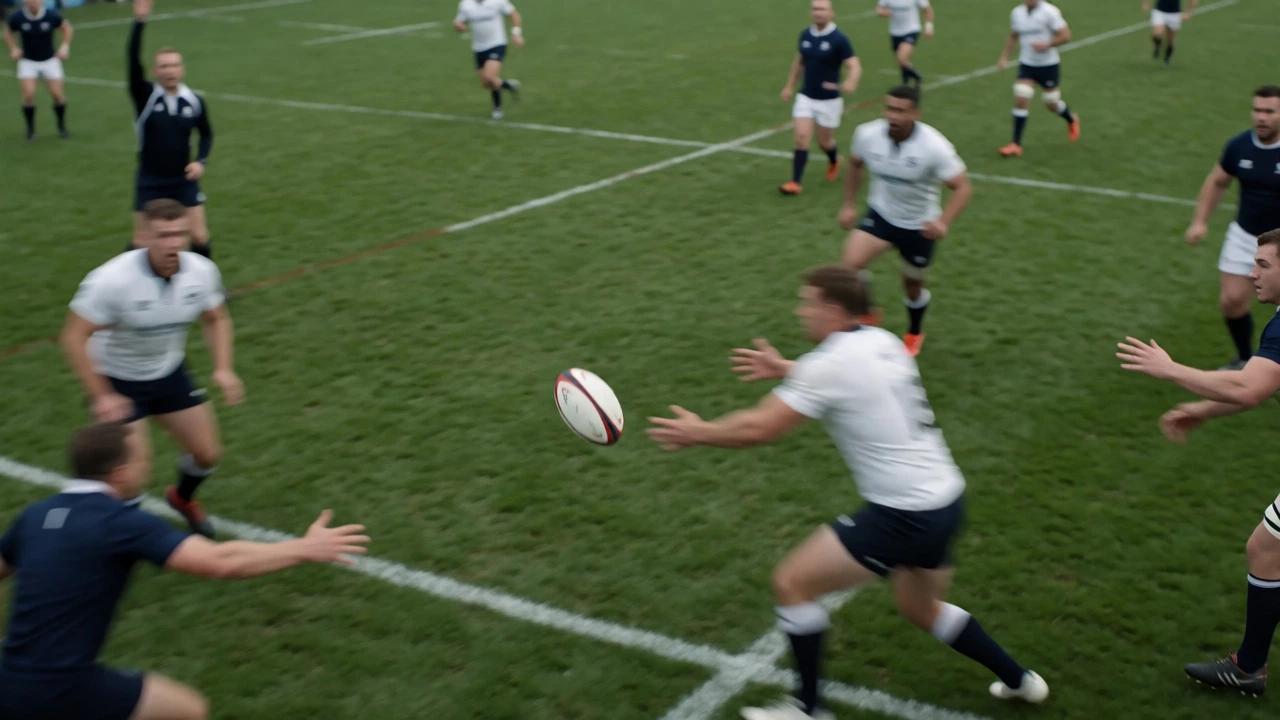
If there is one rule that defines rugby, it’s this: you cannot pass the ball forward. It sounds simple, but it causes more penalties than any other infraction. In Rugby Union and Rugby League, the ball must travel backward or sideways when passed between teammates. If it moves toward the opponent’s try line during the hand-off, it’s a knock-on or a forward pass.
Why does this matter? Because it forces teams to advance through running, kicking, and strategic positioning rather than just lobbing the ball ahead like in American football. When a forward pass happens, the opposing team gets a scrum. This resets possession and gives the defense a chance to reorganize. Watch closely next time; if the receiver catches the ball further downfield than where the passer released it, the ref will blow the whistle.
Dangerous Tackles and High Contacts
Tackling is essential, but how you tackle matters. You cannot make contact with an opponent above the shoulder. This includes the head and neck area. Historically, players would sometimes wrap arms around the neck or hit the head with their shoulder. Today, laws protect the brain. Any contact with the head results in a penalty, and if it’s deemed dangerous, the tackler faces disciplinary action.
There’s also the concept of the "no arms" tackle. You can’t just run into someone and push them over without wrapping your arms around them. While not always penalized in open play if the player goes to ground quickly, referees increasingly look for proper technique. More critically, you cannot tackle a player who doesn’t have the ball. If Player A has the ball and Player B runs past him, Player C cannot grab Player B just because he’s nearby. That’s obstruction or unnecessary contact.
| Infraction | Description | Penalty |
|---|---|---|
| Forward Pass | Ball travels forward during handoff | Scrum to opposition |
| High Tackle | Contact above shoulder/head | Penalty + Potential Card |
| Offside | Player ahead of last foot/kick | Penalty Kick |
| Collapse | Maul falls due to defender's weight | Penalty Scrum |
| Knock-On | Accidental forward loss of control | Scrum to opposition |
Offside Positions: Invisible Walls
Offside in rugby isn’t about being out of bounds; it’s about timing and position relative to the ball. This is tricky because the offside line changes constantly. Generally, you cannot be ahead of the teammate who last played the ball. If you’re standing five meters in front of your fly-half as he receives a kick, you’re offside. You need to retreat behind the last foot of your team or the kicker.
In open play, if you’re offside and interfere with play, the ref awards a penalty. But here’s a nuance: you can be offside and still get away with it if you don’t impact the game. Referees often use the "fair catch" rule. If you’re offside but let a fair catch happen without interfering, play continues. However, if you charge down a kick from an offside position, that’s a penalty. It requires spatial awareness that takes years to master.

Mauls and Rucks: No Collapsing
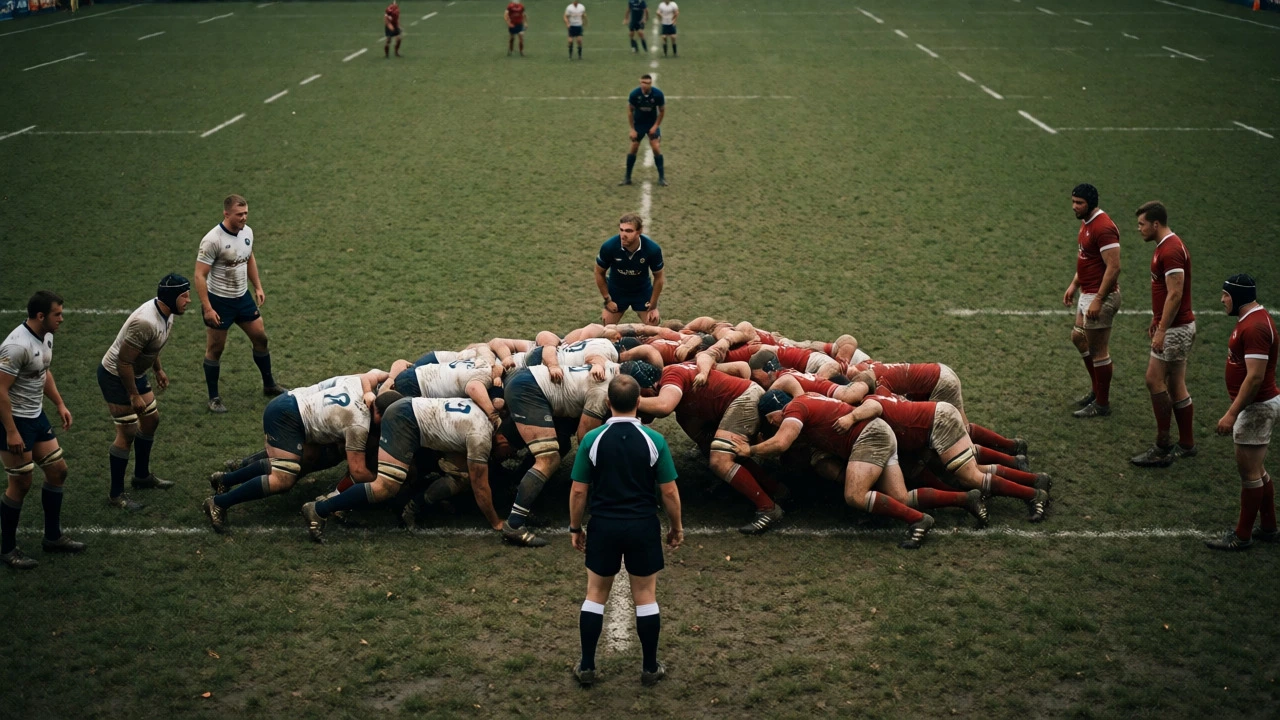
When a player carrying the ball is held by one or more opponents, a ruck forms. Players bind onto each other to contest possession. You cannot collapse a ruck or maul intentionally. If you’re part of a maul (a moving pack of players) and you dive to the ground to stop it, that’s a penalty. It’s considered unfair play because it stops momentum artificially.
Similarly, you cannot jump into a ruck from the side. You must join from behind the hindmost foot of your own side. Jumping in from the side is called "side entry." It’s dangerous because it creates instability and potential injuries. Referees watch the feet of players entering these contests closely. If your first foot lands beside the ball carrier rather than behind the last player, you’re likely offside or committing a side-entry offense.
Kicking Errors: Knock-Ons and Double Hits
A knock-on happens when a player accidentally loses control of the ball, and it hits the ground or an opponent before going forward. It’s different from a forward pass because it’s unintentional. The result is the same: a scrum to the non-offending team. But context matters. If a player drops the ball straight down, it’s not a knock-on. It has to go forward.
Then there’s the double-hit. You cannot kick the ball twice in succession unless an opponent touches it first. If you punt the ball, chase it, and then kick it again because no one touched it, that’s a penalty. This rule prevents players from essentially dribbling the ball forward with their feet indefinitely. It keeps the game flowing and encourages handling skills.
Conduct and Discipline
Beyond technical fouls, behavior matters. You cannot argue with the referee in a way that disrupts the flow of the game. Only the captain speaks to the ref. Dissent leads to penalties. Physical misconduct includes striking, gouging, biting, or eye-gouging. These are severe offenses. A strike, even accidental, can lead to a sin bin (yellow card) or sending off (red card).
Players also cannot obstruct opponents who don’t have the ball. For example, if a defender runs in front of a chaser to block their path without playing the ball, that’s obstruction. It’s a subtle foul but common in tight games. Referees penalize it to ensure fair competition for space.
Key Takeaways
- No Forward Pass: The ball must go backward or sideways between hands.
- Head Contact is Prohibited: Tackles must be below the shoulder line.
- Respect Offside Lines: Stay behind the last player or kicker.
- Don’t Collapse Contests: Intentionally bringing down a maul or ruck is a penalty.
- Single Kicks Only: You can’t kick the ball twice without an opponent touching it.
Can you pass the ball backwards?
Yes, absolutely. Passing backward is the standard way to move the ball along the backline. As long as the ball does not travel forward relative to the ground during the release and catch, it is legal. Sideways passes are also permitted.
What happens if a player knocks the ball forward?
If a player knocks the ball forward and it hits the ground or an opponent, play stops. The opposing team is awarded a scrum at the place of the infringement. If the knock-on is deliberate, it’s a penalty instead of a scrum.
Is tackling below the waist allowed?
Tackling below the waist is generally legal, provided it’s safe. However, tackles too low can be risky for the attacker’s knees and ankles. Most coaches teach mid-thigh to chest height tackles to balance safety and effectiveness. Tackles above the shoulder are strictly forbidden.
Why is the offside rule so complicated?
The offside rule changes depending on whether the ball is in open play, a set piece, or a ruck. It ensures that defenders cannot camp near the try line waiting for a pass. It forces teams to earn territory through structured play rather than lucky positioning.
Can you pick the ball up from a ruck?
No, you cannot use your hands to pick the ball out of a ruck once it has formed. Players must use their feet to hook the ball back. Using hands in a ruck is a penalty known as "handling in the ruck." This rule protects players’ fingers and maintains the contest structure.