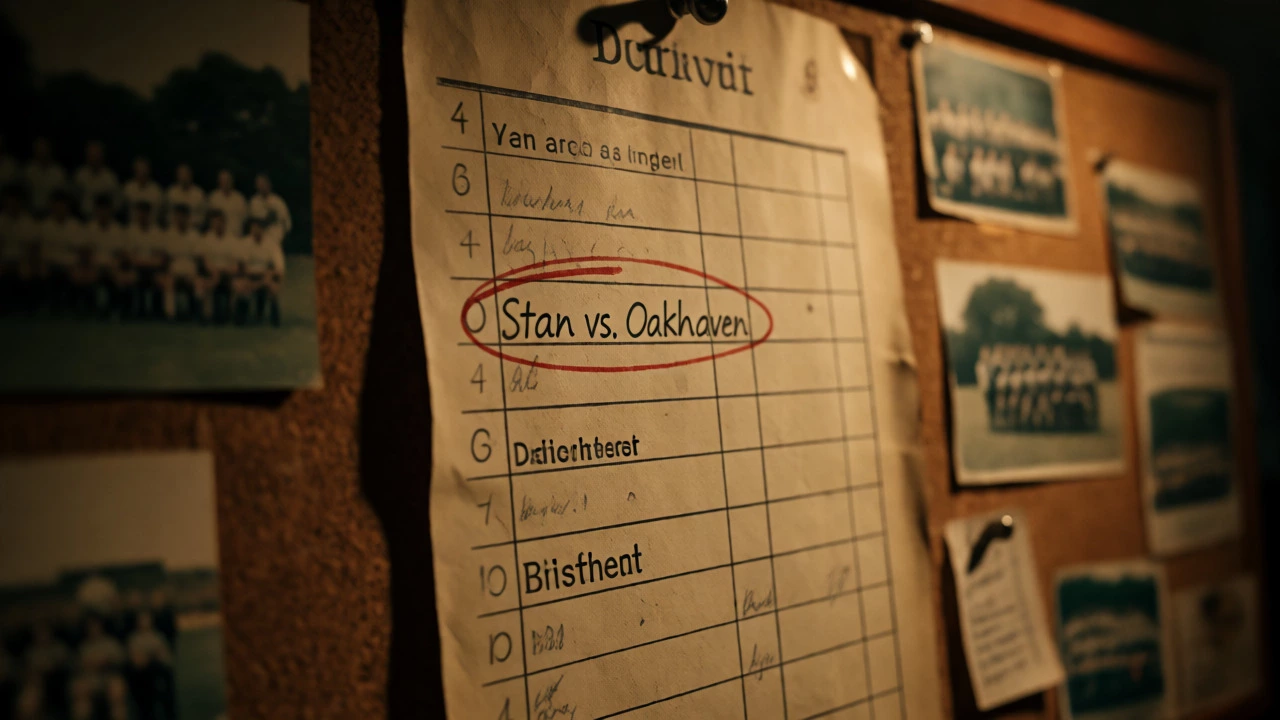
Rugby Fixture "Stan" Decoder
See a match listed as "Stan vs. Oakhaven" or "The Stan Cup"? Don't guess. Use this diagnostic tool to uncover the likely origin of the name.
Diagnostic Questions
Answer the questions on the left to decode the mystery of "Stan".
You’re scrolling through the weekend’s rugby fixtures list on your phone. You see a local club match listed simply as "Stan vs. Oakhaven." Or maybe you hear commentators casually refer to a specific high-stakes tournament round as "The Stan." It sounds like a person’s name, right? Like your uncle Stan who mows his lawn every Sunday. But in the world of professional and semi-pro rugby, names have weight. They aren’t just labels; they are identifiers for history, geography, or sometimes, pure bureaucratic accident.
So, why is it called Stan? If you’ve ever stared at a fixture sheet wondering if you missed a memo about a famous player or a sponsor, you’re not alone. This article breaks down the three most likely reasons a rugby fixture gets tagged with this moniker. We’ll look at historical sponsorship, geographic shorthand, and the weird world of internal database coding that leaks into public view.
The Sponsorship Ghost: When Brands Become Names
Let’s start with the most common culprit: money. In modern rugby, especially at the club level in the UK, Australia, and South Africa, team names often reflect their primary sponsors. But here’s the twist-sometimes the sponsor changes, but the nickname sticks. Imagine a company called "Stanley & Sons" sponsored a regional league in 1995. For twenty years, everyone called the cup final "The Stanley Cup" (not the NHL one, obviously). Even after Stanley went bankrupt in 2015, fans still call the current championship "The Stan." It’s linguistic inertia.
This phenomenon isn’t unique to rugby. Think about how people still say "Xerox" when they mean "photocopy." In rugby fixtures, if a tournament was historically known by a sponsor whose name started with Stan-, the abbreviation survives. I’ve seen this happen in county-level competitions where a fixture is listed as "County Shield (Stan Series)" long after the contract ended. The database hasn’t been updated, or worse, the organizers like the ring of it. It’s shorter than "The 2026 Regional Championship Phase 2," which is a mouthful when you’re trying to fit text onto a small mobile screen.
If you check the official governing body’s archive for the specific competition, you might find a legacy link. Look for any entity named Stanley, Standard, or Stansfield. If they were major backers in the 90s or early 2000s, that’s your smoking gun. The name "Stan" is essentially a fossil record of financial support.
Geographic Shorthand: Is There a Town Called Stan?
Rugby is deeply tied to place. Teams represent towns, villages, and boroughs. Sometimes, a fixture is labeled "Stan" because it’s shorthand for a location. Is there a town called Stanmore? Yes. Is there a Stansted? Yes. Could a fixture be referring to a match involving teams from these areas, or perhaps a neutral venue located in a place with "Stan" in its name?
Consider the logistics of scheduling. A neutral ground is often required for cup ties or finals. If the chosen venue is in a suburb called Stanford-le-Hope, or near Stanmore, the fixture coordinator might type "Venue: Stan" into the system. Over time, if the system pulls the venue code instead of the full city name, the fixture appears as "Match at Stan." It’s lazy data entry, plain and simple. But it’s also efficient for locals who know exactly what "Stan" means in their context.
Here’s a quick way to test this theory: Look at the opposing team. Are they from London? Then "Stan" likely refers to Stanmore RFC or a nearby venue. Are they from Essex? Maybe it’s related to a local landmark. Geography dictates identity in rugby more than almost any other sport. If the name doesn’t match a person or a brand, bet on the map.

The Database Glitch: Internal Codes Leaking Out
Now for the least glamorous, but very real, explanation: IT systems. Large sporting organizations use complex databases to manage thousands of fixtures. Each team, venue, and tournament has a unique alphanumeric code. What if the code for a specific tournament tier is "STAN"? Or what if the developer used "Stan" as a placeholder variable during testing and forgot to change it before going live?
I’ve worked with sports data feeds where placeholder text persists for months. Imagine a backend table where `tournament_type = 'STANDARD'` gets truncated to `STAN` in the API response due to a character limit error. Suddenly, every standard league match shows up as "Stan Match" on fan apps. It’s not poetic; it’s a bug. But until the dev team pushes an update, fans are left scratching their heads.
To spot this, look for consistency. Does every match in a certain tier get called "Stan"? If yes, it’s likely a category label (Standard vs. Elite vs. Junior). If only one random match is called "Stan," it’s probably a typo or a specific identifier for a special event, like a charity match organized by someone named Stan.
Comparing the Possibilities
How do you figure out which scenario applies to your specific fixture? Use this decision matrix. It’s not perfect science, but it cuts through the noise faster than asking on Reddit.
| Hypothesis | Likelihood | Key Indicator | Actionable Check |
|---|---|---|---|
| Sponsor Legacy | High | Historical news articles mention a sponsor starting with Stan-. | Search the club’s website archives for past sponsors. |
| Venue Location | Medium | The match is at a neutral site in a town with "Stan" in the name. | Check the address field in the fixture details. |
| Database Code | Low-Medium | All matches in a specific tier share the label. | Compare with other fixtures in the same division. |
| Person Tribute | Low | The match is part of a memorial or charity event. | Look for "In Memory Of" tags in the description. |

Real-World Example: The "Stanley Cup" Confusion
Let’s make this concrete. In 2018, a regional rugby union league in the Midlands rebranded their end-of-season festival. Previously, it was the "Midlands Summer Sevens." The new title sponsor was a construction firm called "Stanley Build." Within weeks, local pubs and Facebook groups were calling it "The Stan." By 2024, even though the sponsor had changed twice, the fixture list still read "Round 1: The Stan." New players joining the league asked, "Who is Stan?" Veterans laughed. It wasn’t a person. It was a ghost of a contract. This shows how quickly commercial language overrides descriptive accuracy in sports culture.
What Should You Do Next Time You See It?
Don’t panic. And don’t assume you’re missing insider knowledge. Most of the time, "Stan" is harmless clutter. Here’s your checklist:
- Check the Date: Is it a recent fixture? If so, look for new sponsors announced in the last 12 months.
- Check the Venue: Is the location unusual? If it’s a neutral ground, search the area for "Stan" locations.
- Check the Pattern: Is it just one game, or a whole series? One game suggests a special event; a series suggests a systemic label.
- Ask Locals: Rugby communities talk. Ask a supporter group on social media. Someone will know the backstory within ten minutes.
Rugby traditions are built on stories. Sometimes those stories are about legendary tries or brutal tackles. Sometimes, they’re about a spreadsheet cell that didn’t get renamed. Either way, understanding the "why" makes you feel more connected to the game. It turns a confusing acronym into a conversation starter.
Is "Stan" a specific rule in rugby?
No, "Stan" is not a rule, position, or scoring term in the Laws of Rugby. It is almost certainly a proper noun reference-either a person, place, or brand-or a technical artifact from the fixture management software.
Could Stan be a player’s nickname?
It’s possible, but unlikely to appear in the official fixture title unless it’s a tribute match. Usually, player nicknames stay in commentary or fan chants, not the printed schedule. If it is a tribute, the fixture description will usually include "Memorial" or "Benefit."
Why do fixture lists change names?
Fixture names change due to sponsorship renewals, league restructuring, or updates to the digital platforms hosting the schedules. Often, old names persist in third-party apps even after the official league updates them, creating confusion.
Does "Stan" mean Standard League?
Yes, this is a strong possibility. Many leagues categorize divisions as Premier, Championship, National, and Standard. If the database abbreviates "Standard" to "Stan," it will appear on the fixture list. Check if other games in the same tier have similar abbreviated names.
Where can I verify the true name of the fixture?
Always go to the primary source: the official website of the governing body (like the RFU, WRU, or NZR) or the specific club’s site. Third-party aggregators often lag behind or contain cached errors.