Rugby History Timeline & Myth Buster
The Evolution of the Game
Click on any event card to learn more about this pivotal moment.
Foundation of Rugby School
Lawrence Sheriff founds the school that would eventually give its name to the sport.
The Webb Ellis Legend
William Webb Ellis allegedly picks up the ball and runs, though historians view this as a myth.
First Written Rules
Three masters at Rugby School write down the first official code of laws, allowing handling.
Formation of the RFU
The Rugby Football Union is established, formalizing the split from Association Football.
The Great Schism
Northern clubs break away over player payments, forming what becomes Rugby League.
Test Your Knowledge
Loading question...
Quiz Complete!
You scored 0 out of 0.
It’s a question that comes up more often than you’d think. You’re watching a match, maybe checking the latest rugby fixtures, and someone asks: "Why is it even called rugby?" It doesn’t sound like a sport. It sounds like a place. And technically, they are right. The name isn't derived from a type of ball, a specific move, or a mythical creature. It comes straight from the town where the game was born.
The story is simple, but the truth behind it is messy. To understand why we call this brutal, beautiful game "rugby," we have to go back to a small market town in Warwickshire, England, and look at a school that changed sports forever.
The Town That Gave Its Name to a Sport
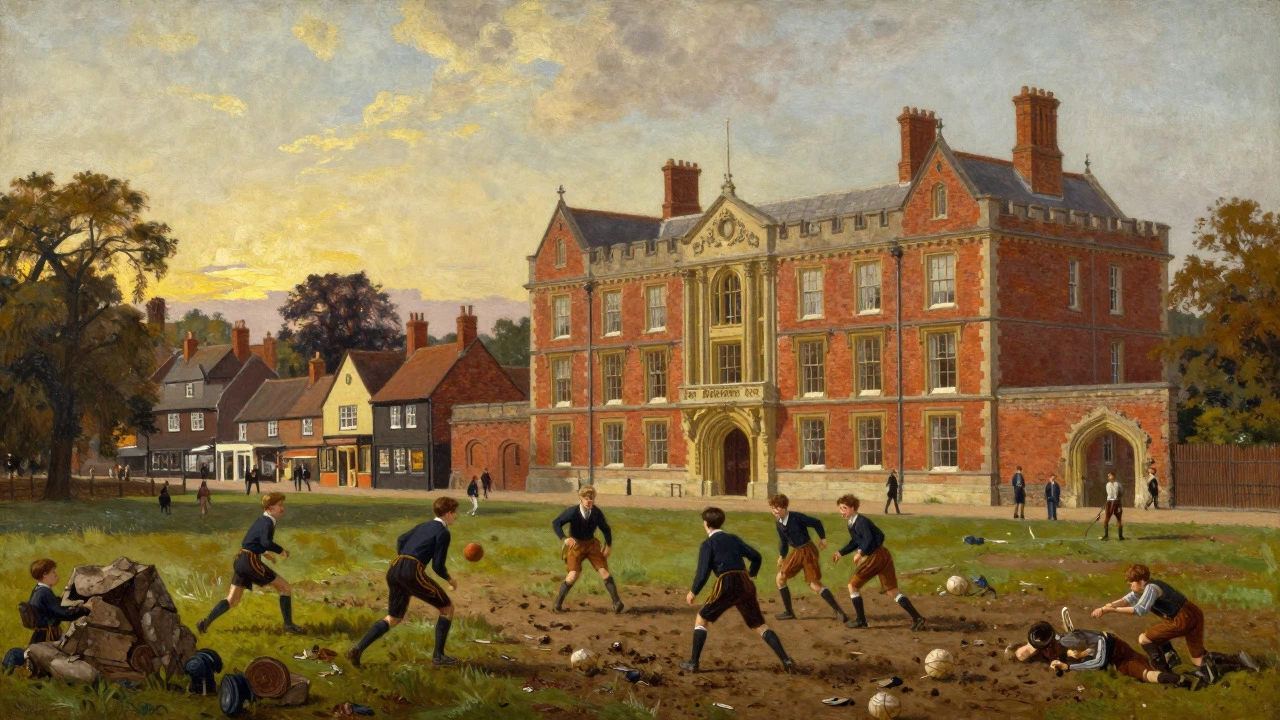
Rugby is a real place. It’s a historic town in the West Midlands of England, about 90 miles northwest of London. For centuries, it was just another English town with a castle, a market square, and a population focused on agriculture and trade. But in the 19th century, it became famous for one thing: Rugby School is an independent boarding school for boys founded in 1567 by Lawrence Sheriff.
Before the 1800s, "football" wasn't a single game. If you played football in an English village, you were likely playing a chaotic mob game involving hundreds of people, no fixed rules, and goals that could be anywhere. Different schools had different ways of playing. At Eton, they played one way. At Harrow, another. At Rugby School, they developed their own distinct style.
When the game started spreading beyond the school gates, people needed a way to distinguish it from the other versions of football being played elsewhere. They didn't say "Lawrence Sheriff's Game." They said "The Rugby Game." Over time, the "The" dropped off, and it became simply "Rugby."
The Myth of William Webb Ellis
If you ask anyone about the origins of rugby, they will eventually mention William Webb Ellis is a student at Rugby School who allegedly picked up the ball and ran with it in 1823. The story goes that during a particularly boring football match in 1823, Webb Ellis ignored the rules, grabbed the ball with his hands, and ran toward the goal. This act of rebellion supposedly created the sport.
This story is beloved by fans. There is even a statue of him at Twickenham Stadium in London, holding the ball as if he just made the decision to change history. However, historians generally agree that this is a myth. Or at least, a heavily exaggerated legend.
Here’s the reality check: there is no contemporary evidence that Webb Ellis did this. No diaries, no newspaper reports, no letters from teachers complaining about the incident. The first written mention of this event didn't appear until nearly 50 years later, in 1876, by someone named Francis H. Mason. By then, the game had already evolved significantly.
So, did Webb Ellis invent rugby? Probably not. But did he play a role? Maybe. What is certain is that the students at Rugby School were experimenting with handling the ball long before 1823, and long after. The "myth" serves a purpose-it gives us a hero and a dramatic moment-but the actual development of the sport was a slow, gradual process of rule-making, not a single epiphany.
How the Rules Were Actually Written
If Webb Ellis didn't invent the game in a single afternoon, how did it become what it is today? The answer lies in bureaucracy, not bravery. In the mid-19th century, British public schools realized they needed standardization. You can't have a national sport if every school plays by different rules.
In 1845, three masters at Rugby School wrote down the first official code of laws for the game. These rules allowed players to handle the ball, pass it backward, and kick it forward. This was a radical departure from the kicking-only styles prevalent in other parts of England. These rules weren't perfect, and they weren't universal, but they provided a framework.
The real turning point came in 1871. Representatives from various clubs met in London to form the Rugby Football Union (RFU) is the governing body for rugby union in England, established in 1871. They codified the rules based largely on the practices at Rugby School. This formalized the split between "rugby" (where you could carry the ball) and "association football" (soccer), which had its own union formed shortly after.
This distinction is crucial. Before the RFU was formed, many clubs played a hybrid game. Some allowed handling; some didn't. The formation of the RFU locked in the identity of the sport. It wasn't just "football with hands." It was now "Rugby Football."

The Great Schism: Why There Are Two Types of Rugby
You might wonder why we have Rugby Union and Rugby League. This isn't part of the original naming story, but it’s essential context for understanding the modern landscape. The split happened in 1895, not because of the name, but because of money.
In Northern England, working-class players often missed work to play matches. They suffered financial losses. The southern-dominated RFU refused to allow payments to compensate them, viewing it as "professionalism" which tainted the amateur spirit. Frustrated northern clubs broke away and formed the Northern Rugby Football Union is the organization formed in 1895 that later became the Rugby Football League. They introduced changes to the game, including reducing the team size from 15 to 13 players and introducing a system of play-the-ball.
Despite the split, both codes retained the name "Rugby." One became known as Rugby Union (the original code), and the other as Rugby League. The name stuck because the roots were shared. Both games trace their lineage back to those same fields in Warwickshire.
Why Didn't It Get a Different Name?
Think about other sports. Basketball got its name from the equipment used. Tennis comes from the French word "tenez" (hold). Soccer is a slang abbreviation of "Association Football." Why didn't rugby get a cooler name? Why not "Running Ball" or "Carry Foot"?
The reason is prestige. In Victorian England, public schools were the centers of social power. Being associated with Rugby School was a badge of honor. It signaled education, discipline, and class. Naming the game after the school lent it authority. It wasn't a street game; it was an institution's game.
Additionally, the term "Rugby" was already distinct. When people said "Football," they usually meant soccer. Saying "Rugby" immediately clarified which version of the game you were discussing. It was efficient. It was recognizable. And once the global spread began through British colonization and migration, the name traveled with the players.
| Feature | Rugby Union | Rugby League |
|---|---|---|
| Origin Year | 1871 (RFU formed) | 1895 (Split from Union) |
| Governing Body Origin | Rugby Football Union (England) | Northern Rugby Football Union |
| Primary Motivation | Standardizing school rules | Financial compensation for players |
| Team Size | 15 players | 13 players |
| Key Rule Difference | Scrum restarts, no play-the-ball | Play-the-ball restarts, limited tackles |

The Global Spread and Retention of the Name
As British sailors, soldiers, and settlers moved around the world, they brought their games with them. Rugby took root in New Zealand, Australia, South Africa, and France. In each country, the local communities adopted the game but kept the name. They didn't rename it "Kiwi Ball" or "Southern Hemisphere Football." They kept "Rugby" because it connected them to the source of the culture.
This retention of the name helped build a global identity. Whether you are in Melbourne watching the Wallabies or in Cardiff cheering for Wales, you are participating in the same tradition. The name acts as a historical anchor. It reminds everyone that despite the differences in playstyles, tactics, and national pride, the core of the game remains the same.
Today, when we talk about rugby, we aren't just talking about a set of rules. We are referencing a specific place in England that valued physical education and character building. The name is a tribute to that heritage. It’s a reminder that the sport grew out of a schoolyard, shaped by boys who wanted to run with the ball, and formalized by men who wanted to keep order.
Common Misconceptions About the Name
There are a few persistent myths that need clearing up. First, some people believe "rugby" is a slang term for rough play. While the game is certainly physical, the word has no linguistic connection to "rough." Second, some think the name was chosen arbitrarily by the RFU. It wasn't. It was descriptive. It told you exactly where the rules came from.
Another misconception is that the game was invented solely by William Webb Ellis. As discussed, while he may have been an early enthusiast, the evolution of the game was a collective effort by students, teachers, and club officials over decades. The name reflects the institution, not the individual.
Understanding the origin of the name adds depth to the way we watch the game. When you see a player pick up the ball and run, you aren't just seeing a tactical move. You are witnessing the culmination of a tradition that started in a small English town over 150 years ago. The name "rugby" carries that history with it, every time the whistle blows.
Who actually invented rugby?
While William Webb Ellis is credited with picking up the ball and running in 1823, historians believe this is a myth. The game evolved gradually at Rugby School, with rules being codified in 1845 by school masters. It was a collective development rather than a single invention.
Why is it called rugby and not football?
In England, "football" generally refers to soccer (Association Football). To distinguish the game played at Rugby School, which allowed handling the ball, it was called "Rugby Football." Over time, the "Football" part was dropped in common usage, leaving just "Rugby."
The name distinguishes it from Association Football (soccer). Since Rugby School allowed handling the ball, it was called "Rugby Football" to differentiate it from the kicking-only games played elsewhere. Eventually, it was shortened to just "Rugby."
What is the difference between Rugby Union and Rugby League?
The split occurred in 1895 due to disagreements over paying players. Rugby Union remained amateur initially and kept 15 players per side. Rugby League allowed professionalism, reduced teams to 13 players, and introduced the play-the-ball rule. Both retain the name "Rugby" due to their shared origins.
Where is Rugby School located?
Rugby School is located in the town of Rugby, Warwickshire, England. It is about 90 miles northwest of London. The town itself gave its name to the sport.
Is William Webb Ellis a real person?
Yes, William Webb Ellis was a real student at Rugby School in the early 19th century. However, there is no contemporary evidence that he invented the game by picking up the ball. The story became popular much later, in the 1870s, as a way to create a founding myth for the sport.